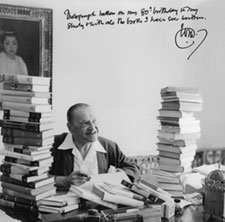
I hope Mr. Ross will forgive me for this, but I just couldn't help posting this.
Elliott Templeton expresses his conventional views on the act of marriage many times throughout the novel. Why do you think it's so important and formal to him? Do you think his views are wrong? How do you feel about Larry and Isabel and their prospects for marriage?
Also, Maugham describes Isabel's youth almost as if it was a character itself. What part do you think the idea of youth plays in this novel?
-L. Adams

Subscribe to:
Post Comments (Atom)


.JPG)




3 comments:
No problem, Lindsay, though all of us, remember that these are public comments, so must make sure our spelling and grammar is up to par.
Regarding your question. First of all, it is interesting that Elliott would put such stock in marriage, considering he will obviously never marry himself--well, unless it is to an old, old, arch-duchess in some Medieval castle in the Pyrenees somewhere. But I think he looks upon marriage as the logical foundation for "joining" society. It seems that those who are unmarried at a certain age, are suspect in their prospects for getting ahead. I highly doubt that Isabel and Larry will get married. It just does not seem to be in the cards for Larry. It does bring up a very important topic, i.e., the necessity for marriage at all. I mean, what is today's divorce rate, and what does that say about the "convention" of marriage?
--Mr. Ross
I agree with the assertion that Isabel and Larry will never get married. Larry is too much of an individual, and too preoccupied with his own thoughts. In regards to the "necessity of marriage," I think this too plays into the theme of - yes, individual v. community.
Isabel is good-hearted, but hopelessly materialistic and community-oriented. To be happy, she needs the approval of others and involvement in society. A critical part of the vision she has for her life is the conventionality of marriage.
Larry, on the other hand, defies that conventionality and focusing on himself rather than others (selfish, but not necessarily in a negative way). Larry places importance on different things than Isabel. Giving meaning to his own existence, answering "unanswerable questions," etc., form the fundamental groundwork of his values. He can survive without others, Isabel cannot.
It could be argued that Larry, in his pursuit of knowledge, is in his selfish way bettering the world in a more significant way than Isabel, in all her generosity, is.
Isabel and Larry will never get married (rhyme?!) because their values are simply too different.
-Haney
Post a Comment